
Designing What Doesn’t Exist Yet
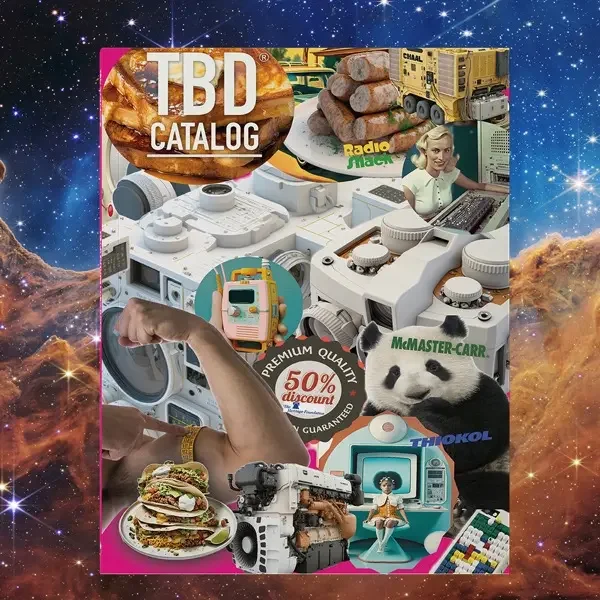
What if graphic design wasn’t just about communicating the present, but imagining the future?
As designers, we usually create things for a world that already exists. We design advertisements for existing products, websites for existing companies, packaging for products that are already being sold, and posters for events that are actually happening. But what happens when the thing we are designing does not exist yet?
That is where design fiction becomes interesting. Instead of designing something to immediately solve a real-world problem, design fiction uses design to explore possible futures. It asks questions like What if this technology became normal? What would people’s lives look like? What would they need? And would that future actually be a good thing?
Designing a Possible Future
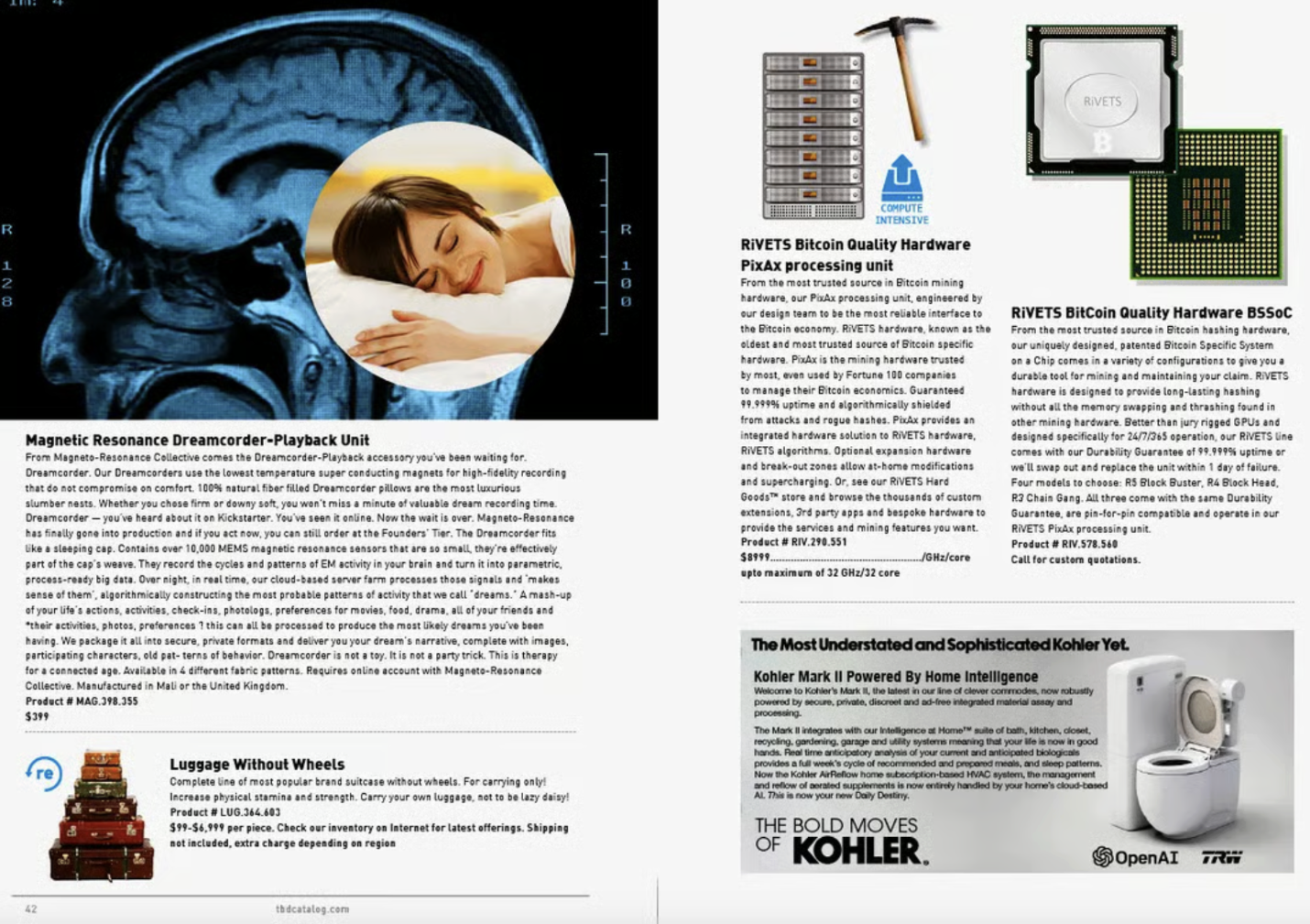
The TBD Catalog uses familiar graphic-design conventions to make fictional future products feel believable.
Design fiction is not necessarily about predicting the future. It is more about making an imagined future feel real enough that people can think about it. This can be done through products, advertisements, interfaces, publications, environments, or even fictional brands.
This idea connects to speculative design research from designers Anthony Dunne and Fiona Raby. Instead of treating design just as a way to make existing products more useful or attractive, they describe design as a way to explore ideas and possible futures.
One example that stood out to me is the TBD Catalog created by the Near Future Laboratory. The project imagined what an ordinary product catalog from a possible future might look like. Instead of simply presenting futuristic concepts as sketches, the designers treated them as if they were real products. The project included product names, descriptions, advertisements, imagery, and editorial content. The graphic design helped make the fictional world believable.
My Own Experience With Future Design
This became more apparent to me while working with The Thing from the Future. You start with four cards Arc, Terrain, Object, and Mood, with these constraints the game forces you to combine different elements of a future scenario and turn an abstract idea into something more specific. Instead of starting with a finished product and figuring out how to make it look good, the process starts with imagination. It was especially interesting to suspend disbelief when designing these things, since they’re supposed to exist in the near yet distant future I tried making things that sound unrealistic but still have the ability to be created at some point.
That process was so different from the type of design work I normally do. Usually, I have a client, audience, product, or message that gives me some boundaries. With future-focused design, those boundaries become much less certain. I have to decide what kind of world I am imagining and then figure out what visual details would make that world believable, for this example particularly I went as dramatic and out there as I could get.
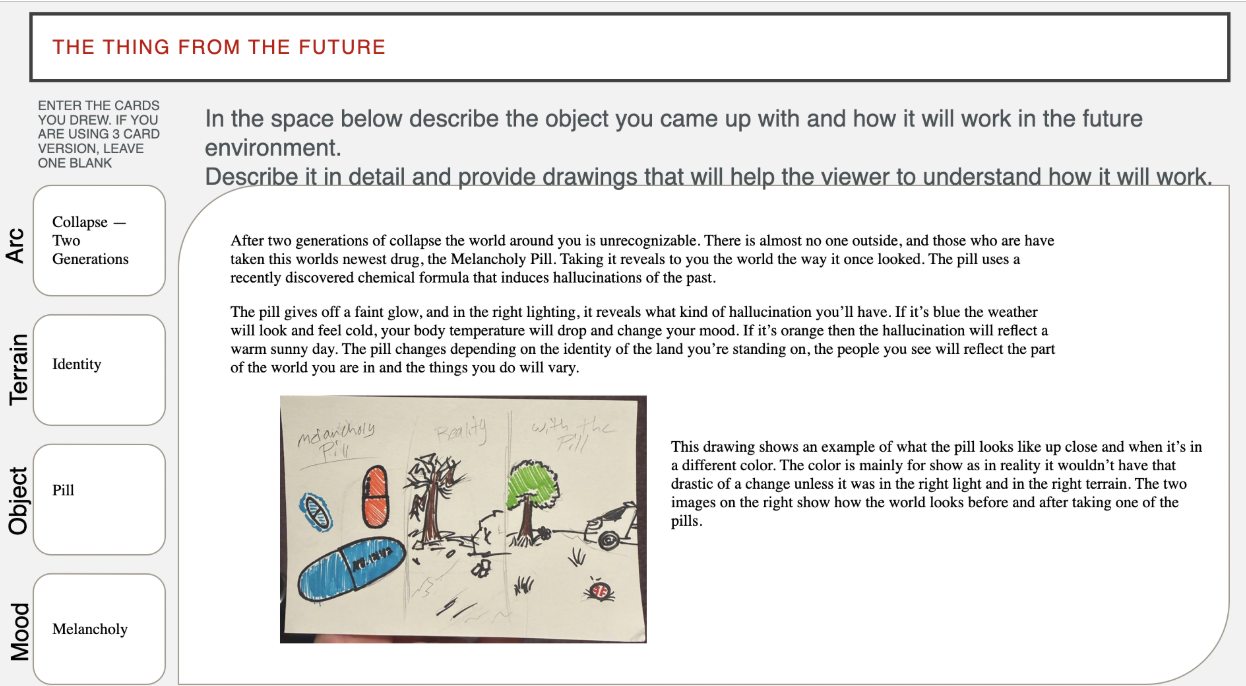
One of the handouts that I completed, this is the Melancholy Pill.
The exercise also showed me why scenario planning can be useful for designers. The goal isn’t necessarily to guess exactly what will happen. Instead, considering multiple possible futures gives designers more possibilities to work with. One future might be optimistic, another could be inconvenient or strange, and another could be somewhere in between.
That changes the question from “What will the future look like?” to “What could the future look like?”
Why Designers Should Care
Design fiction gives visual designers an opportunity to participate in conversations about technology, culture, and society before those things become reality. It can expose potential problems, explore new opportunities, or simply make people question assumptions about where the world is heading.
For me, the biggest takeaway is that designing for the future does not mean trying to predict it perfectly. It means being willing to imagine possibilities and use visual communication to make those possibilities understandable.
A designer might create a fictional app, product, advertisement, magazine, or brand that represents a future that hasn’t happened yet. The artifact itself might never become real, and that is okay. Its purpose can just be to make people stop and ask: Would we actually want this?
That is what makes design fiction valuable. Graphic design can do more than show us the world as it is. It can give us a way to see worlds that don’t exist yet, and decide what kind of future we want to create.
